
And how to stay grounded anyway
Summer has a reputation for being relaxing. Longer days. More sunlight. Flexible schedules. Time outside. Less rigid structure.
At least, that’s how it’s usually described.
But for many adults—especially parents, caregivers, and high-responsibility households—summer doesn’t feel relaxing. It feels destabilizing. School schedules disappear. Work routines shift. Childcare arrangements change. Household timing becomes unpredictable. Meals happen later—or not at the usual time. Bedtimes stretch into unfamiliar territory.
What used to be automatic becomes manual. And somewhere in the middle of it all, something subtle begins to happen. You feel scattered. Not overwhelmed in one dramatic moment—but gradually.
You forget small things. You feel more tired than expected. Your patience feels shorter. Your days feel less predictable. And the quiet question starts forming:
Why does summer feel harder than it should?
Not because summer is bad. But because summer changes structure. And when structure changes, stability shifts with it.
EDUCATION & TRUTH
Seasonal changes affect stability more than most people realize. Summer disrupts routine patterns that normally support cognitive efficiency and emotional regulation. During the school year—or any structured season—daily life tends to follow predictable timing:
- Wake times
- Meal times
- Work start and end points
- Transportation routines
- Bed preparation patterns
These predictable patterns reduce mental workload because the brain learns what to expect. Expectation conserves energy. When summer arrives, those expectations shift. Not gradually. Quickly.
Children remain home. Schedules loosen. Sleep timing changes. Daylight increases stimulation hours. Social demands often increase. Work responsibilities remain unchanged.
This creates a mismatch between available structure and required output.
The result:
- Increased decision fatigue
- Reduced cognitive efficiency
- Sleep inconsistency
- Emotional reactivity
- Physical fatigue
- Increased household stress
Not because people lack discipline. Because structure was removed. This aligns directly with the REBUILD philosophy: Stability is not emotional—it is structural.
When structure weakens, stability weakens. Even during positive seasons.
WHAT STABILITY ACTUALLY LOOKS LIKE
Many people assume summer stability means maintaining the same routines as the rest of the year. That expectation often creates frustration. Summer stability does not mean:
- Strict schedules identical to school-year routines
- Perfect daily timing
- Complete productivity
- Constant organization
- Maintaining every previous system
Instead, summer stability looks like:
- Simplified routines
- Predictable anchor points
- Flexible—but defined—daily expectations
- Reduced non-essential obligations
- Clear household timing signals
- Preserved recovery windows
Stability during summer is not rigidity. It is intentional flexibility. This is a critical difference. Flexibility without structure creates chaos. Flexibility with anchors creates stability.
That is how seasonal transitions remain manageable.
RECOGNITION MOMENT
Many people blame themselves when summer routines collapse. They assume they are less disciplined. Less organized. Less capable. But the reality is simpler:
Summer removes systems that previously supported stability.
Here are recognition signs that summer disruption—not personal failure—is affecting your daily functioning:
- Bedtimes drift later without intention
- Meals become inconsistent
- Household tasks pile up faster
- Decision fatigue increases
- Daily transitions take longer
- You feel mentally scattered
- Your patience threshold lowers
- Sleep quality declines
- Responsibilities feel harder to manage
- Days feel less predictable
These signs are not personal weakness. They are structural instability.
And structural instability requires rebuilding—not guilt.
PRACTICAL RECOGNITION STEPS
Using the REBUILD Cycle Philosophy
Summer stability requires intentional movement through the REBUILD Cycle. Not rigid control. Structured flexibility.
Step 1 — Recognize What Summer Changed – (REBUILD Phase: Recognize)
List:
- What routines disappeared
- What responsibilities increased
- What timing shifted
Recognition makes disruption visible. Visibility creates control.
Step 2 — Establish Core Summer Anchors – (REBUILD Phase: Establish Stability)
Identify three daily anchor points. Examples:
- Wake window
- Meal timing
- Evening shutdown routine
Anchors maintain predictability—even when schedules shift.
Step 3 — Believe Flexibility Can Still Be Stable – (REBUILD Phase: Believe & Become)
Flexibility does not equal chaos. With structure, flexibility becomes manageable. Without structure, flexibility becomes destabilizing.
Belief shapes implementation.
Step 4 — Understand New Daily Demands – (REBUILD Phase: Understand)
Ask: What tasks increased during summer? Examples:
- Child supervision
- Transportation changes
- Meal preparation
- Household noise management
Understanding demand prevents overload.
Step 5 — Implement Simplified Systems – (REBUILD Phase: Implement)
Create repeatable summer routines. Examples:
- Pre-planned meals
- Defined quiet hours
- Scheduled cleanup times
Simple systems reduce decision fatigue.
Step 6 — Live the Summer Pattern Consistently – (REBUILD Phase: Live It)
Repetition builds seasonal stability. Not strict control.
Reliable patterns.
Step 7 — Design Seasonal Recovery Points – (REBUILD Phase: Design & Decide)
Summer often increases output. Recovery must increase as well.
Design rest intentionally. Not accidentally.
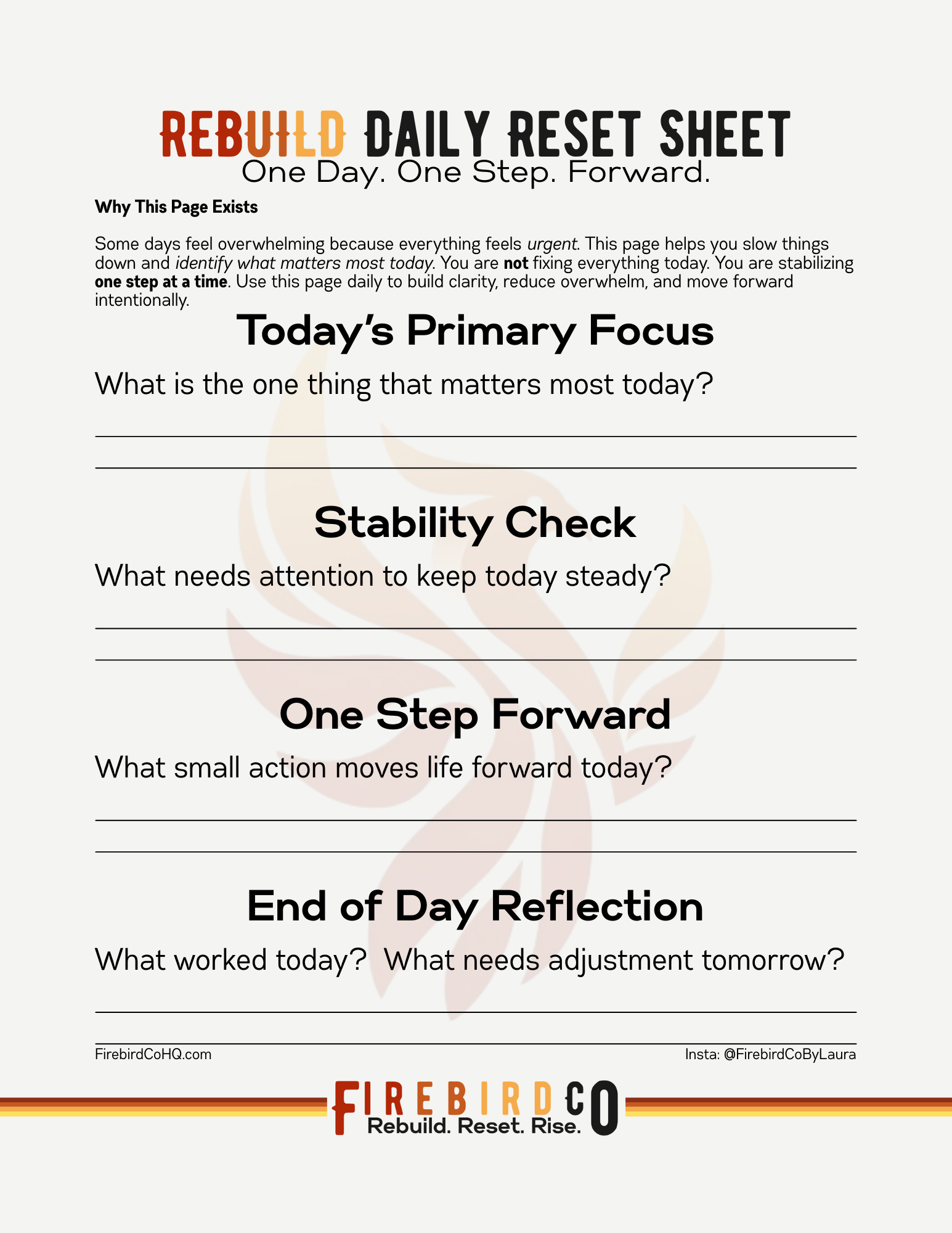
The FirebirdCo Daily Reset Sheet becomes especially valuable during summer because it restores visibility when routines shift.
Instead of guessing what needs attention, the Daily Reset Sheet helps you:
- Track daily anchors
- Maintain consistent routines
- Reduce decision fatigue
- Monitor workload changes
- Stabilize household timing
Summer chaos decreases when structure becomes visible. Visibility builds control.
DAILY APPLICATION
Summer stability requires repeatable adjustments—not major overhauls. Start with containment. Not perfection.
Create a Summer Anchor Schedule
Choose three fixed points daily. Examples:
- Morning readiness window
- Midday meal
- Evening shutdown sequence
Consistency protects energy.
Simplify Daily Expectations
Reduce: Optional tasks.
Summer adds unpredictability—simplification protects capacity.
Pre-Plan Key Decisions
Examples:
- Weekly meal plans
- Activity timing
- Household responsibilities
Pre-planning reduces daily strain.
Protect Evening Shutdown Time
Longer daylight disrupts sleep timing. Create visible cues:
- Lights dimmed
- Screens limited
- Noise reduced
Sleep stability supports emotional regulation.
NORMALIZATION
Summer disruption is not a failure of discipline. It is a shift in structure. And structure affects stability more than motivation ever will.
If your days feel scattered during summer, you are not falling behind. You are adapting to seasonal change. Adaptation requires:
- Adjustment
- Observation
- Repetition
- Structure
Not pressure. Not perfection.
Recognition is not criticism. Recognition is stabilization.
And stabilization protects your capacity—even during seasonal disruption.
If summer disruption is affecting your daily life, structured rebuilding can restore stability. The FirebirdCo Renaissance Reset Workbook was created to help individuals rebuild structure during shifting life phases—including seasonal changes. Inside the Renaissance Reset Workbook, you’ll:
- Identify disrupted routines
- Build seasonal stability systems
- Reduce decision fatigue
- Restore daily clarity
- Rebuild predictable structure step by step
Summer does not have to feel chaotic. With structure, flexibility becomes manageable.
And manageable life supports stability.
In the next article, we’ll explore why sleep becomes harder during summer months—and how to stabilize rest even when schedules shift.
Because sleep is one of the first systems affected by seasonal instability. And protecting sleep protects everything else.


Leave a comment