
Why change disrupts stability—and how to rebuild structure during transition
Life transitions rarely arrive quietly. They show up with paperwork. Boxes. Phone calls. New schedules. Unfamiliar routines. Decisions stacked on top of decisions.
Sometimes it’s a move. Sometimes it’s a job change. A relationship ending. A diagnosis. A child leaving home. A financial shift that changes how daily life operates.
And in the middle of it all, something unsettling starts to happen. You forget things. You lose track of details. Your patience shortens. Your energy drops faster than usual. Small problems feel larger than they should.
And somewhere inside that chaos, a familiar fear creeps in: Am I falling apart?
But here’s the truth most people are never told: Life transitions are destabilizing by design. Not emotionally dramatic. Structurally disruptive. And when structure shifts, stability shifts with it. That’s not failure.
That’s transition.
EDUCATION & TRUTH
Life transitions place intense strain on cognitive and physiological systems because they disrupt predictability. Predictability is one of the brain’s primary stabilizers. When daily life becomes predictable, the nervous system conserves energy. When predictability disappears, the brain increases alertness. This is not theoretical. It is biological. Transitions increase:
- Decision load
- Environmental uncertainty
- Emotional processing demand
- Physical fatigue
- Time pressure
- Risk awareness
Each of these increases stress hormone output. Over time, repeated decision-making during transition creates decision fatigue, a measurable reduction in mental clarity caused by excessive choices. Sleep disruption is also common during transitions. Not because something is wrong. Because uncertainty increases vigilance. The brain scans for potential threats when conditions change.
Even positive transitions—like promotions, moves, or new opportunities—can produce instability because they require adaptation. That’s the key truth: Transitions don’t destabilize because they are bad. They destabilize because they change structure.
And structure is what keeps life manageable.
WHAT STABILITY ACTUALLY LOOKS LIKE
During transition, stability looks different than it does during routine life. It does not mean:
- Feeling calm all the time
- Having everything figured out
- Avoiding stress
- Maintaining perfect routines
- Moving through change without mistakes
Instead, stability during transition looks like:
- Maintaining small predictable actions
- Keeping essential routines intact
- Reducing unnecessary decisions
- Preserving recovery windows
- Prioritizing essentials over perfection
- Accepting temporary inefficiency
Stability during transition is not about control. It is about containment. You are not stopping the transition. You are stabilizing inside it. This aligns directly with the REBUILD philosophy: You do not rebuild after life stabilizes. You rebuild while life is shifting.
RECOGNITION MOMENT
Many people believe transitions should feel exciting, empowering, or energizing. But the reality is:
Transitions are exhausting—even when they are necessary.
Ignoring this exhaustion increases instability. Here are recognition signs that a life transition is destabilizing your system:
- You feel mentally scattered
- You forget routine tasks
- Your patience threshold decreases
- You feel physically fatigued without clear cause
- Your sleep becomes inconsistent
- You feel emotionally reactive
- Small decisions feel overwhelming
- You struggle to prioritize tasks
- Your routines feel fragmented
- You feel uncertain about what happens next
These are not signs that you’re failing. They are signs that structure has shifted. And whenever structure shifts, rebuilding must begin.
PRACTICAL RECOGNITION STEPS
Using the REBUILD Cycle Philosophy
Transitions require moving intentionally through the REBUILD Cycle—not rushing, not skipping.
Step 1 — Recognize What Has Changed – (REBUILD Phase: Recognize)
Write down:
- What is ending
- What is beginning
- What responsibilities are shifting
Change becomes manageable when it becomes visible.
Step 2 — Establish Core Stability Anchors – (REBUILD Phase: Establish Stability)
Identify non-negotiable daily actions. Examples:
- Wake time
- Meals
- Sleep preparation
- Medication routines
- School or work departure timing
These anchors stabilize your nervous system. Not perfectly.
Consistently.
Step 3 — Believe Instability Is Temporary – (REBUILD Phase: Believe & Become)
Transitions create temporary instability—not permanent collapse. Belief in recovery matters. Not emotionally. Structurally.
Step 4 — Understand New Demands – (REBUILD Phase: Understand)
Ask:
- What new decisions must be made daily?
- What responsibilities are increasing?
- What routines are disappearing?
Understanding prevents overwhelm.
Step 5 — Implement Micro-Structure – (REBUILD Phase: Implement)
Create small systems. Examples:
- Written task lists
- Scheduled pauses
- Defined daily checkpoints
Small structure prevents large collapse.
Step 6 — Live the New Pattern Daily – (REBUILD Phase: Live It)
REPETITION stabilizes transition. Not speed. Not intensity.
Step 7 — Design the Next Stable System – (REBUILD Phase: Design & Decide)
Transitions end. New routines emerge. Design them intentionally.
Not reactively.
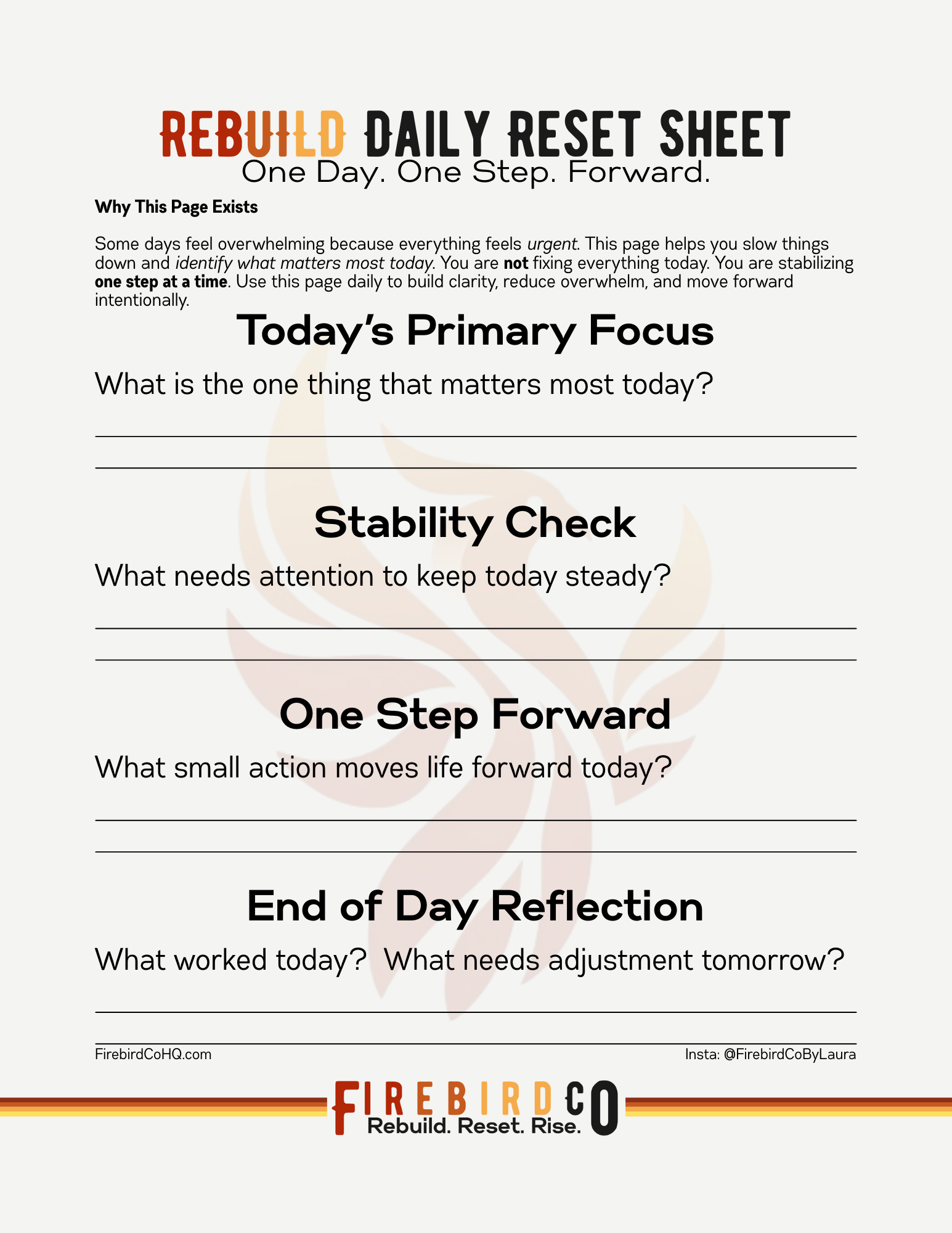
This is exactly where the FirebirdCo Daily Reset Sheet becomes critical.
Transitions create chaos because responsibilities multiply while structure disappears. The Daily Reset Sheet restores visibility by helping you:
- Identify essential daily actions
- Track responsibilities clearly
- Maintain predictable routines
- Reduce decision fatigue
- Stabilize your day during change
When life shifts, visibility protects stability.
DAILY APPLICATION
Transitions require daily containment—not perfection. Start small. Stay consistent.
Create a Transition Stability List
Write three things that must happen daily. Not ten. Three. Examples:
- Meals
- Work arrival
- Bed preparation
Essentials stabilize life.
Limit Non-Essential Decisions
During transitions, decision fatigue increases quickly. Reduce:
- Optional commitments
- New projects
- Unnecessary planning
Conserve mental energy.
Schedule Recovery Windows
Recovery is not optional during transition. Examples:
- Five-minute pauses
- Quiet time between tasks
- Physical movement breaks
Small recovery protects capacity.
Track Daily Completion — Not Perfection
Ask: “What did I complete today?”
Not: “What did I fail to finish?”
Completion builds confidence. Confidence stabilizes transition.
NORMALIZATION
Life transitions feel destabilizing because they are destabilizing. Not emotionally fragile. Structurally disruptive. You are not falling apart. You are adapting to change. And adaptation requires:
- Time
- Structure
- Observation
- Repetition
Not pressure. Not perfection. Recognition is not weakness. Recognition is control.
And control builds stability—even inside transition.
If you’re navigating a life transition, structured rebuilding matters more than ever. The FirebirdCo Renaissance Reset Workbook was designed specifically to help people stabilize during major life shifts. Inside the Renaissance Reset Workbook, you’ll:
- Recognize transition stress patterns
- Build predictable daily structure
- Restore clarity during change
- Reduce overwhelm
- Rebuild stability step by step
Transitions do not have to destroy stability. They require rebuilding. And rebuilding creates strength.
In the next article, we’ll explore why decision fatigue increases during life transitions—and how to reduce mental overload before it leads to burnout. Because transitions don’t just change your environment. They change your mental capacity.
And learning to manage that capacity changes everything.
 FirebirdCo
Leave a comment