
how loss reshapes the ground beneath you
Grief doesn’t always arrive as tears. Sometimes it shows up as confusion. You walk into a room and forget why you’re there. You reach for your phone to call someone who is no longer available. You hear a sound, smell something familiar, or pass a place that carries memory—and suddenly your body reacts before your mind understands why. Grief doesn’t just affect emotions.
It interrupts patterns. Routines that once made sense feel unfamiliar. Schedules feel heavier than they used to. Even simple tasks feel strangely difficult. And somewhere in the middle of daily life, a quiet realization forms:
Nothing feels stable anymore.
Not because everything is gone. But because something important is missing. Loss does more than create sadness. It reshapes the structure of life itself. And when structure shifts, stability shifts with it. That is where grief becomes destabilizing—not just emotionally, but structurally.
EDUCATION & TRUTH
Grief is often described as emotional pain. But physiologically and neurologically, grief is also a disruption of expectation and memory patterns. The human brain builds stability through repetition.
Daily life creates neurological shortcuts—patterns that allow the brain to conserve energy by predicting what happens next. When loss occurs, those predictions break. This creates cognitive strain because the brain continues to reference patterns that no longer exist. For example:
- Expecting to hear a familiar voice
- Reaching for shared routines
- Anticipating interactions that no longer occur
- Holding space for responsibilities that have changed
This mismatch between expectation and reality increases mental load. Research into grief and memory processing shows:
- Increased cognitive fatigue
- Difficulty concentrating
- Memory disruption
- Reduced executive functioning
- Sleep disturbances
- Heightened emotional sensitivity
- Physical fatigue and lowered immunity
These responses are not emotional weakness. They are neurological adaptation. Grief reshapes the brain’s internal map of reality. Not instantly. Gradually. And during that reshaping process, stability becomes fragile. That is why grief often feels disorienting.
Not just sad. Disorienting.
WHAT STABILITY ACTUALLY LOOKS LIKE
Many people assume stability during grief means emotional control. That belief creates unnecessary pressure. Stability during grief does not mean:
- Feeling calm
- Avoiding sadness
- Maintaining productivity
- Moving forward quickly
- “Getting over it”
Stability during grief looks like:
- Maintaining basic routines
- Completing essential responsibilities
- Allowing emotional fluctuation without collapse
- Preserving physical health where possible
- Protecting energy
- Continuing daily life at a slower pace
Stability during grief means: Life continues—even when it feels different. Not perfectly. Not easily. But consistently. This aligns directly with the REBUILD philosophy:
You do not rebuild by erasing grief. You rebuild by stabilizing around it.
Grief does not disappear. But life can stabilize again.
RECOGNITION MOMENT
Grief destabilizes more than emotions. It destabilizes memory, identity, and expectation. Ignoring that reality makes recovery harder. Here are recognition signs that grief is affecting stability—not just mood:
- You forget routine tasks more often
- You feel physically tired without clear cause
- Your concentration drops noticeably
- Familiar routines feel unfamiliar
- You feel disconnected from time or sequence
- Your sleep patterns change
- You feel sudden emotional shifts triggered by memory
- You avoid places or activities tied to memory
- Decision-making feels slower
- Your tolerance for stress decreases
These are not signs that grief is overwhelming you. They are signs that your internal structure is adapting to loss. And adaptation requires stabilization. Not pressure.
PRACTICAL RECOGNITION STEPS
Using the REBUILD Cycle Philosophy
Grief recovery follows the REBUILD Cycle—not emotionally, but structurally.
Step 1 — Recognize What Has Changed – (REBUILD Phase: Recognize)
Loss changes more than relationships. It changes:
- Daily routines
- Responsibilities
- Expectations
- Emotional patterns
- Time allocation
Write down what no longer exists in your routine. Not abstractly. Specifically. Recognition makes grief visible. Visibility supports stabilization.
Step 2 — Identify Disrupted Patterns – (REBUILD Phase: Recognize)
Notice: What routines feel hardest now? Examples:
- Morning routines
- Evening quiet time
- Mealtime habits
- Household responsibilities
Grief often appears strongest where routines once held memory.
Step 3 — Establish Replacement Stability Anchors – (REBUILD Phase: Establish Stability)
Not replacements for the person. Replacements for structure. Examples:
- New morning rhythm
- Scheduled quiet reflection
- Simplified daily routines
- Defined rest periods
Structure rebuilds predictability. Predictability rebuilds stability.
Step 4 — Allow Gradual Adaptation – (REBUILD Phase: Believe & Become)
Grief recovery is not linear. Adaptation occurs in cycles. Belief that stability can return is not denial.
It is structural expectation.
Step 5 — Implement Micro-Structure – (REBUILD Phase: Implement)
Keep routines simple. Examples:
- Written schedules
- Repeating daily actions
- Visible reminders
Small systems reduce cognitive strain.
Step 6 — Live the Stabilized Pattern – (REBUILD Phase: Live It)
Repeat essential routines. Not perfectly. Reliably.
Repetition creates safety signals in the brain.
Step 7 — Design a Life That Holds Memory Without Collapse – (REBUILD Phase: Design & Decide)
Memory does not disappear. Life grows around it.
Stability includes memory—not avoidance.
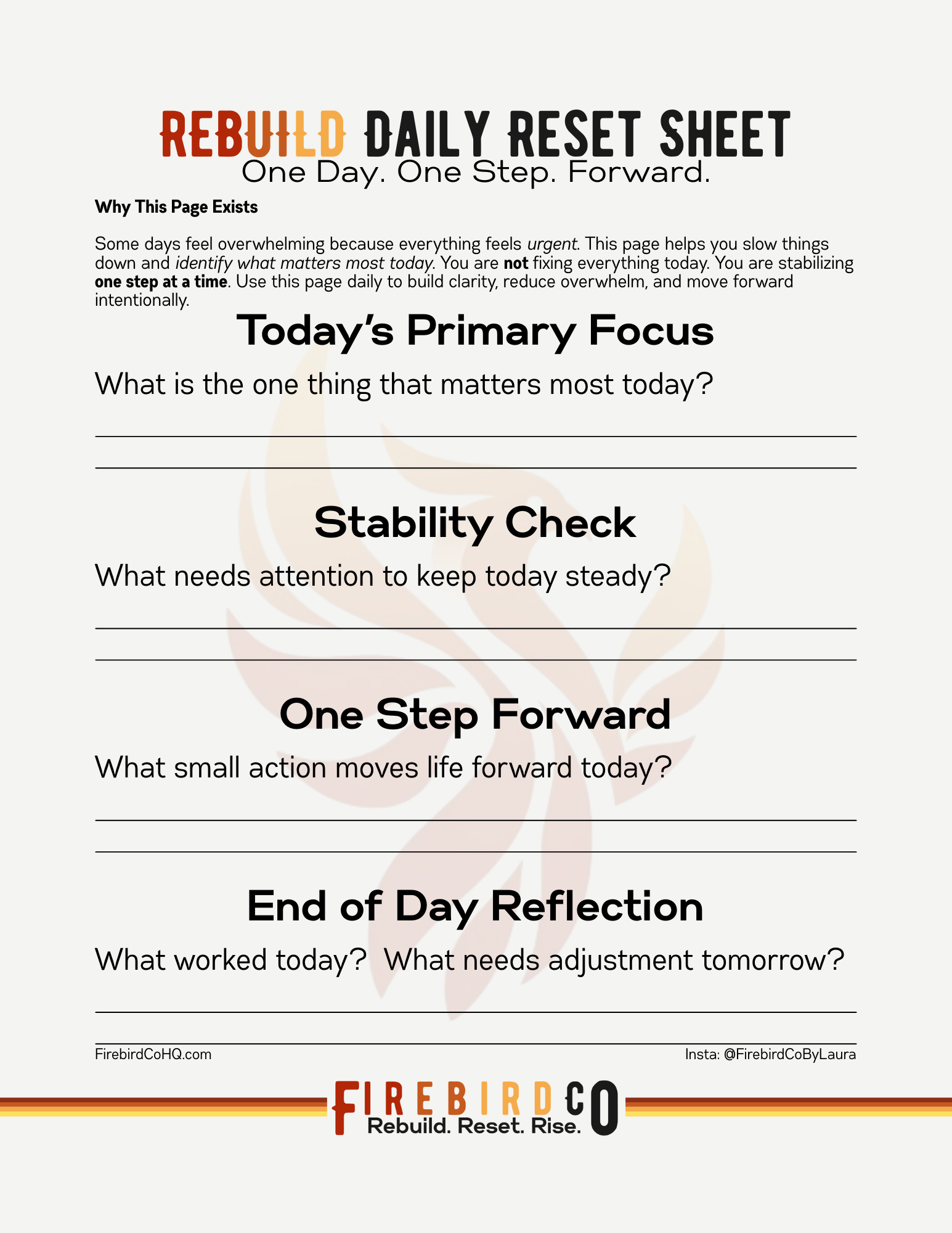
The FirebirdCo Daily Reset Sheet is especially valuable during grief because grief disrupts routine memory. When routines become unreliable, visibility restores control. The Daily Reset Sheet helps you:
- Track essential daily actions
- Maintain predictable routines
- Reduce mental strain
- Stabilize daily functioning
- Preserve structure during emotional fluctuation
During grief, small structure protects stability.
DAILY APPLICATION
Grief recovery happens in small daily actions—not large emotional breakthroughs. Start with stability, not solutions.
Maintain Three Daily Constants
Choose: Three predictable actions. Examples:
- Wake sequence
- Meal timing
- Sleep preparation
Consistency protects neurological stability.
Create One Memory-Safe Moment
Memory will appear unexpectedly. Create intentional space for it. Examples:
- Quiet reflection
- Journaling
- Sitting without distraction
Intentional memory processing reduces emotional shock cycles.
Reduce Decision Load
Grief increases cognitive fatigue. Simplify choices where possible. Examples:
- Repeat meals
- Limit optional commitments
- Follow written routines
Simplification protects capacity.
Track Functional Completion
Ask: “What did I complete today?”
Completion supports stability. Even during grief.
NORMALIZATION
Grief reshapes the ground beneath you. Not just emotionally. Structurally. You are not weak for feeling unstable after loss. You are adapting to a new reality. Stability after grief does not erase memory. It creates space for life to continue beside memory.
Recognition is not surrender. Recognition is rebuilding.
And rebuilding is how stability returns—even after loss.
If you’re navigating grief, structured rebuilding can provide stability when life feels unpredictable. The FirebirdCo Renaissance Reset Workbook was designed to help individuals rebuild daily structure during times of deep life disruption—including loss. Inside the Renaissance Reset Workbook, you’ll:
- Identify disrupted routines
- Restore daily structure
- Stabilize energy patterns
- Reduce overwhelm
- Rebuild capacity step by step
Grief does not end stability. But rebuilding restores it. One routine. One day. One action at a time.
In the next article, we’ll explore why memory triggers appear suddenly during grief—and how to manage those moments without feeling overwhelmed. Because memory is not the enemy. Unmanaged disruption is.
And learning how to stabilize memory responses changes recovery.


Leave a comment