
Why personal recovery doesn’t require stepping away from responsibility
REALITY
There’s a version of rebuilding that sounds simple on paper:
- Take time off.
- Focus on yourself.
- Step away from responsibilities.
- Heal first—then return.
But for many adults, that version of rebuilding simply doesn’t exist because there are children who still need rides to school. Parents who still depend on you. Bills that still arrive. Work deadlines that don’t pause. Households that still run—or fall apart—based on your effort.
Most people rebuilding their lives are not doing it in quiet isolation. They’re doing it in motion. They’re rebuilding while packing lunches. While answering emails. While managing schedules. While holding together systems that would collapse without them. And somewhere inside all of that movement, a quiet thought starts forming:
How am I supposed to rebuild myself while still carrying everyone else?
Not in frustration. In exhaustion. In responsibility. In reality. Because stepping away is not always an option. But rebuilding is still necessary.
EDUCATION & TRUTH
Caregiver strain and chronic responsibility overload are among the most misunderstood contributors to mental instability. Not because they are rare. But because they are normalized.
Many adults function in a state of continuous output—giving energy, attention, time, and resources to others without sufficient recovery. Over time, this creates measurable physiological and psychological strain. Research on caregiver fatigue and chronic responsibility load shows consistent patterns:
- Elevated stress hormone levels over prolonged periods
- Reduced executive function due to repeated decision fatigue
- Sleep disruption caused by constant vigilance
- Emotional suppression to maintain functionality
- Increased risk of burnout and depressive symptoms
- Decreased personal identity clarity
This does not happen because someone lacks resilience. It happens because responsibility without recovery drains capacity. The brain and nervous system require predictable recovery windows to maintain stability. Without those windows, the body begins operating in survival continuity mode—a state where functioning continues, but stability erodes. This is why rebuilding while caring for others feels so difficult.
Not because rebuilding is impossible. But because rebuilding requires structure—and structure often disappears when responsibility expands.
That’s where the REBUILD Cycle becomes critical. Not as a theory. As a survival system.
WHAT STABILITY ACTUALLY LOOKS LIKE
When you’re responsible for others, stability looks different than it does for someone rebuilding alone. It does not mean:
- Perfect routines
- Quiet mornings
- Long stretches of uninterrupted time
- Total personal freedom
- Emotional calm at all times
Instead, stability while caring for others looks like:
- Predictable micro-structure inside busy days
- Small windows of recovery between responsibilities
- Clear visibility into what must be done
- Reduced decision fatigue
- Realistic capacity awareness
- Systems that prevent constant reactivity
Stability does not mean removing responsibility. It means managing responsibility without losing yourself inside it. This is one of the core truths of the REBUILD Cycle:
You do not rebuild by escaping responsibility. You rebuild by stabilizing inside responsibility.
RECOGNITION MOMENT
Many people who care for others believe their exhaustion is simply part of the job. That their depletion is normal. Expected. Unavoidable. But ignoring personal depletion creates long-term instability—not strength. Here are recognition signs that you are rebuilding while depleted, not stabilized:
- You complete responsibilities but feel emotionally disconnected afterward
- You rarely experience true rest
- You forget personal priorities because others always come first
- Your patience feels thinner than it used to
- You feel responsible for everything, even when it exceeds your capacity
- You delay your own needs indefinitely
- You feel like you’re functioning—but not recovering
- Your identity feels secondary to your responsibilities
- You feel invisible inside your own life
- You feel guilty when you attempt rest
These signs are not signs of failure. They are signs of capacity imbalance. And capacity imbalance is one of the first indicators that rebuilding must begin. Not later.
Now.
PRACTICAL RECOGNITION STEPS
Using the REBUILD Cycle Philosophy
Rebuilding while caring for others requires following the REBUILD Cycle—not all at once, but step by step.
Step 1 — Recognize Your Current Load
(REBUILD Phase: Recognize)
Before changing anything, identify what you’re carrying. List:
- Responsibilities you manage daily
- Responsibilities you manage weekly
- Responsibilities you manage emotionally
Recognition is not complaining. Recognition is measurement. Measurement creates clarity.
Step 2 — Establish Stability Anchors
(REBUILD Phase: Establish Stability)
Identify predictable moments in your day. Not long ones. Reliable ones. Examples:
- Morning wake sequence
- Midday pause
- Evening reset moment
These anchors stabilize your nervous system—even inside chaos.
Step 3 — Believe You Are Worth Stabilizing
(REBUILD Phase: Believe & Become)
Many caregivers silently believe: “I’ll take care of myself later.” Later becomes years.
Stabilization requires belief that your functionality matters—not just your output. Not selfish.
Necessary.
Step 4 — Understand Your Capacity Limits
(REBUILD Phase: Understand)
Observe:
- When your energy drops
- When irritability increases
- When decision fatigue appears
Capacity awareness prevents collapse. Ignoring capacity creates collapse.
Step 5 — Implement Micro-Structure
(REBUILD Phase: Implement)
Add structure in small increments. Not large overhauls. Examples:
- Fixed reset times
- Scheduled pauses
- Written task sequencing
Micro-structure builds stability gradually.
Step 6 — Live the System Daily
(REBUILD Phase: Live It)
Rebuilding is not dramatic. It is repetitive. Consistency builds recovery.
Not intensity.
Step 7 — Design Your Next Sustainable Pattern
(REBUILD Phase: Design & Decide)
Once stability improves, redesign responsibility patterns. Not to remove responsibility.
But to distribute it sustainably.
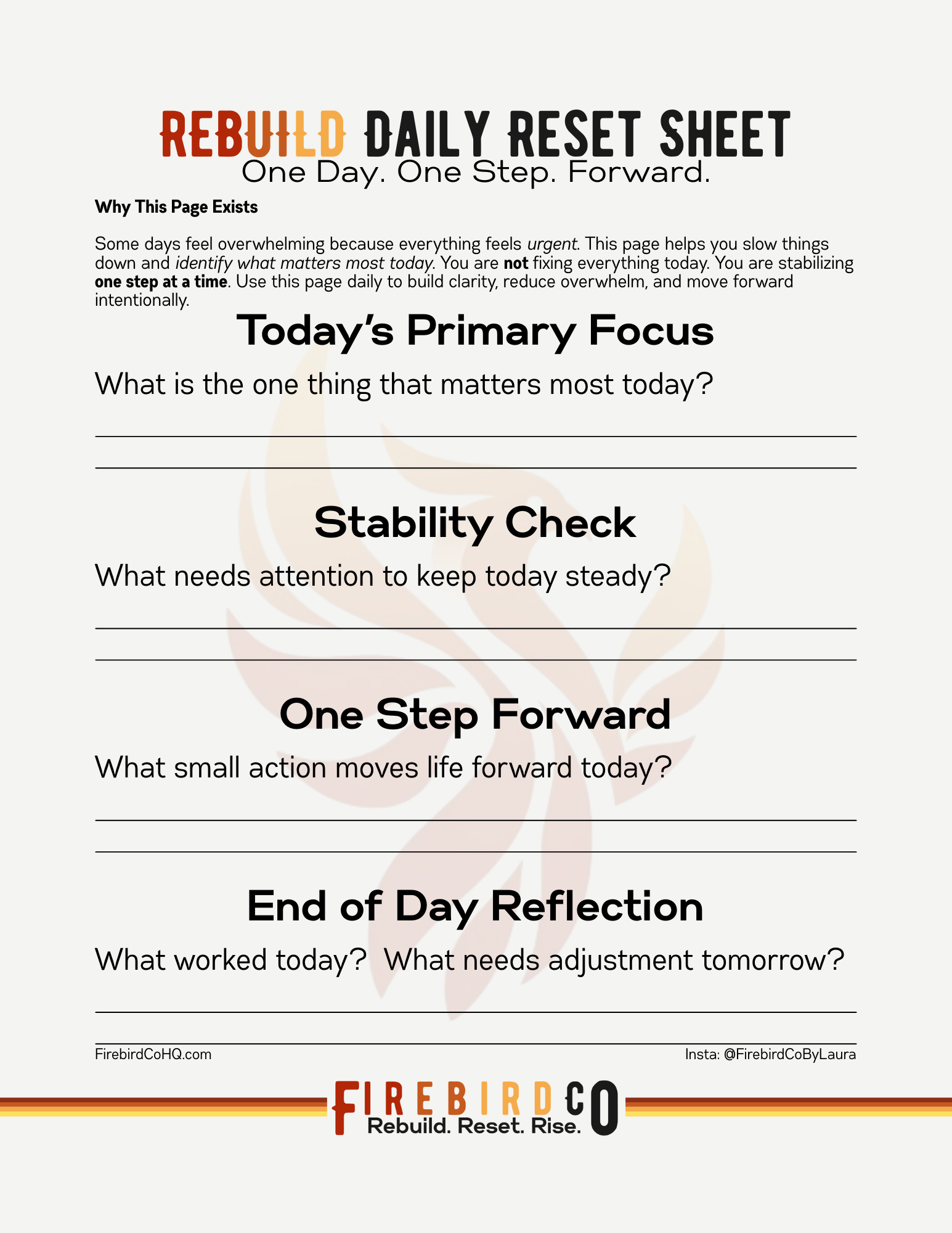
This is where the FirebirdCo Daily Reset Sheet becomes essential.
Not as another task. As a stabilizing system. The Daily Reset Sheet supports the REBUILD process by helping you:
- Identify daily responsibilities clearly
- Track capacity levels
- Create visible recovery points
- Maintain structure inside busy days
When responsibilities feel endless, visibility creates control. And control restores stability.
DAILY APPLICATION
Rebuilding while caring for others requires repeatable systems, not bursts of effort. Start with manageable actions:
Create a Daily Responsibility Map
Write down:
- Must-do responsibilities
- Support responsibilities
- Optional responsibilities
Not everything deserves equal urgency. Clarity reduces overload.
Schedule One Protected Reset Window
Even five minutes counts. Examples:
- Sit quietly without multitasking
- Drink water without interruption
- Step outside briefly
- Breathe intentionally
Recovery does not require isolation. It requires intention.
Identify One Transferable Responsibility
Ask: “What responsibility could be shared, simplified, or delayed?”
Not everything must be carried alone. Redistribution builds sustainability.
Track Personal Energy Daily
Not productivity. Energy. This prevents silent depletion.
NORMALIZATION
Rebuilding yourself while caring for others is not weakness. It is one of the hardest forms of rebuilding that exists. Because you are stabilizing your life while still supporting the lives around you. That requires:
- Patience.
- Structure.
- Awareness.
- Consistency.
Not perfection. Not escape. Not isolation.
Recognition is not selfish. Recognition is responsibility.
And responsible rebuilding creates long-term strength—not short-term survival.
If you’re rebuilding your life while still caring for others, structured rebuilding matters more than ever. The FirebirdCo Renaissance Reset Workbook was designed for exactly this reality. Not for people with unlimited time. For people carrying responsibility while rebuilding stability. Inside the Renaissance Reset Workbook, you’ll:
- Recognize responsibility overload patterns
- Build stability without abandoning responsibility
- Restore clarity under pressure
- Create sustainable daily systems
- Rebuild personal capacity step by step
Rebuilding while caring for others is possible. Not through motivation. Through structure. Through repetition. Through stability. If you’re ready to start rebuilding, get your 30-Day Renaissance Reset Workbook now.
In the next article, we’ll explore how guilt interferes with rebuilding—and why learning to separate responsibility from self-worth changes everything. Because guilt doesn’t just slow recovery. It quietly blocks it.


Leave a comment