
THE RECOGNITION MOMENT
There’s a point where life still looks functional on the outside, but something underneath feels off. Nothing has technically collapsed. The bills are still getting paid. The kids are still getting to school. Work still happens. From the outside, it may even look like you’re handling things better than most.
But internally, something feels different.
It’s the kind of moment where your mind never fully shuts off. Where sleep becomes lighter. Where decisions feel heavier than they used to. Where you start noticing tension in your shoulders, your chest, or your stomach—and it doesn’t go away the way it used to.
You might find yourself telling people, “I’m fine. Just tired.” Or “Things are just busy right now.”
But deep down, there’s often a quiet awareness that this isn’t just busyness. This is usually the point where stability has started to shift—before anything visibly breaks.
And recognizing that shift early matters more than most people realize.
recognize instability in life
Let’s Talk About What’s Actually Happening
What’s actually happening in moments like this isn’t laziness, weakness, or failure. It’s often the early stage of instability.
Instability doesn’t always arrive dramatically. It rarely announces itself with fireworks or obvious warning signs. More often, it creeps in quietly—through accumulation:
- Accumulation of stress.
- Accumulation of responsibilities.
- Accumulation of unresolved decisions.
Research in behavioral science and stress physiology consistently shows that chronic stress doesn’t typically come from one catastrophic event. It builds over time through repeated strain without adequate recovery. When the nervous system remains in a prolonged state of alertness, cognitive load increases, emotional regulation becomes harder, and decision-making capacity decreases.
That’s not opinion—that’s biology.
In real-world situations, this often looks like:
- Taking on more responsibilities than you realistically have capacity for
- Avoiding decisions because everything feels urgent
- Feeling exhausted even after resting
- Noticing that small problems feel disproportionately overwhelming
Most people misunderstand instability. They assume that instability only exists when life visibly falls apart—when jobs are lost, relationships end, or finances collapse.
But instability usually starts long before visible damage occurs.
It begins when your internal capacity is consistently exceeded.
recognize instability in life
What Stability Actually Looks Like
Most people assume stability means everything is easy.
That’s not what stability means.
Stability doesn’t mean life is calm; It means life is manageable. Stable systems have:
• Predictable routines
• Recoverable stress
• Decisions that can be handled without panic
• Enough capacity to absorb disruption
Instability begins when recovery stops happening. Not when things get busy, but when recovery disappears.
That distinction matters.
recognize instability in life
THE HARD TRUTH
Here’s the part that most people struggle to accept:
By the time your life visibly falls apart, instability has usually been present for a long time. Not days. Not weeks. Sometimes months or years.
This matters because ignoring early instability doesn’t make it disappear—it makes it compound. When instability goes unrecognized, what usually happens is slow deterioration. Decision fatigue increases. Patience decreases. Small issues pile up until they become large ones. And eventually, something gives—emotionally, financially, physically, or relationally.
This isn’t about blame; It’s about awareness.
Most people aren’t taught how to recognize instability early. They’re taught to push through discomfort, power through exhaustion, and keep functioning no matter the cost. But functioning isn’t the same as stability. And pretending everything is fine doesn’t preserve strength—it drains it.
recognize instability in life
THE STABILIZATION FRAMEWORK
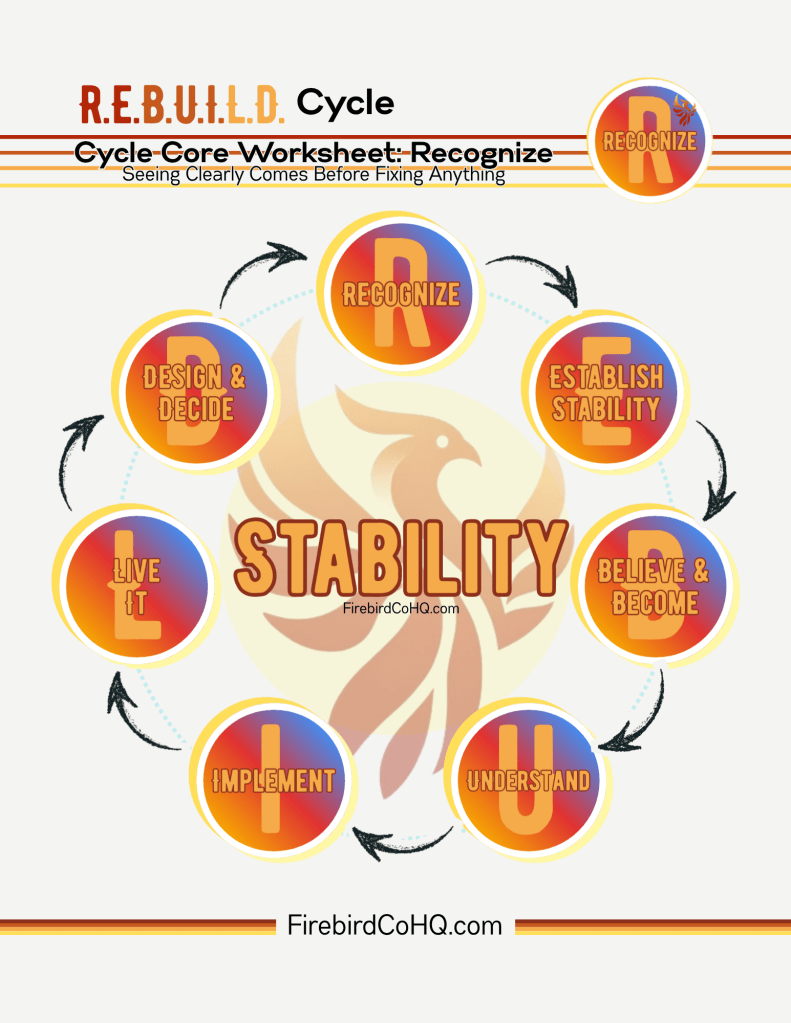
Recognize — The First Step of the R.E.B.U.I.L.D. Cycle
When things feel uncertain, what you need isn’t motivation. You need recognition.
Recognition is the first phase of the R.E.B.U.I.L.D. Reconstruction Cycle™, and it exists for one reason: To help you see clearly what’s actually happening before trying to fix anything.
Step 1 — Recognize the Early Signs
Start by identifying patterns—not isolated moments.
Look for signs like:
- Feeling constantly “on edge” even during calm moments
- Difficulty making decisions that used to feel simple
- Increased irritability or emotional exhaustion
- Feeling behind even when you’re working hard
- Avoiding important conversations or responsibilities
Recognition isn’t dramatic. It’s observational.
Step 2 — Recognize the Sources of Strain
Instability rarely comes from one single cause. It usually comes from layered pressure. Ask yourself:
- What responsibilities increased recently?
- What decisions have been postponed?
- What stressors have remained unresolved?
Naming the source reduces confusion.
Step 3 — Recognize Your Capacity Limits
Every person has limits—physically, emotionally, financially, mentally. Ignoring those limits doesn’t expand them. It overwhelms them. Recognition requires honesty about:
- What you can realistically manage
- What you cannot sustain long-term
- Where your current load exceeds your capacity
If you’re unsure how to identify patterns or warning signs, this is exactly where the REBUILD Recognize Worksheets can help. They give structure to observations that otherwise feel scattered.
recognize instability in life
Here’s What You Can Actually Do Today
Recognition begins with observation—not reaction. You don’t need to fix anything today. You need to see clearly.
- Step 1 — Write down the three things currently causing the most stress.
- Step 2 — Identify whether each stressor is:
- Example
- Stressors:
- Rising credit card balance
- Ongoing conflict at work
- Increasing fatigue
- Categories:
- Financial
- Relational
- Physical
- Answer this: What is Most Urgent:
- Example: Financial pressure
- Example
- Step 3 — Circle the one that feels most urgent.
- Step 4 — Ask: Is this new, or has it been building for a while?
Quick Recognition Checklist
- ☐ I feel more tired than usual, even after rest
- ☐ I avoid decisions because they feel overwhelming
- ☐ I feel mentally overloaded
- ☐ I feel pressure building but can’t clearly define why
- ☐ I feel behind, even when working consistently
If multiple boxes are checked, recognition is overdue.
Reflection
Pause and ask yourself: What feels unstable right now—but hasn’t completely broken yet?
Write your answer without filtering it.
recognize instability in life
Reassurance Without Sugarcoating
Recognition can feel uncomfortable. Not because you’re failing—but because you’re becoming aware.
It takes courage to admit that something isn’t as stable as it used to be. Many people avoid recognition because they fear what they might find. But awareness doesn’t create instability. It reveals it.
And once something is visible, it becomes manageable.
Progress at this stage doesn’t mean fixing everything. It means noticing clearly. It means allowing yourself to see patterns without judgment. You don’t need perfect clarity today. You do need honesty.
And recognition is where rebuilding begins.
recognize instability in life
Thanks for Stopping by!
If this article made you realize things may be less stable than they appear, the REBUILD Recognize Worksheets were created for exactly this stage. They walk you through structured observation so you can identify patterns, stress points, and early warning signs—without guessing. Start the Recognize phase now—before instability compounds: The Daily Reset Worksheet.
recognize instability in life
What Happens After Recognition
Recognition doesn’t solve instability.
It exposes it.
Once instability is visible, the next step is stabilizing the system before further strain occurs. That’s where the next phase begins:
E – Establish Stability
recognize instability in life
 FirebirdCo
Leave a comment